
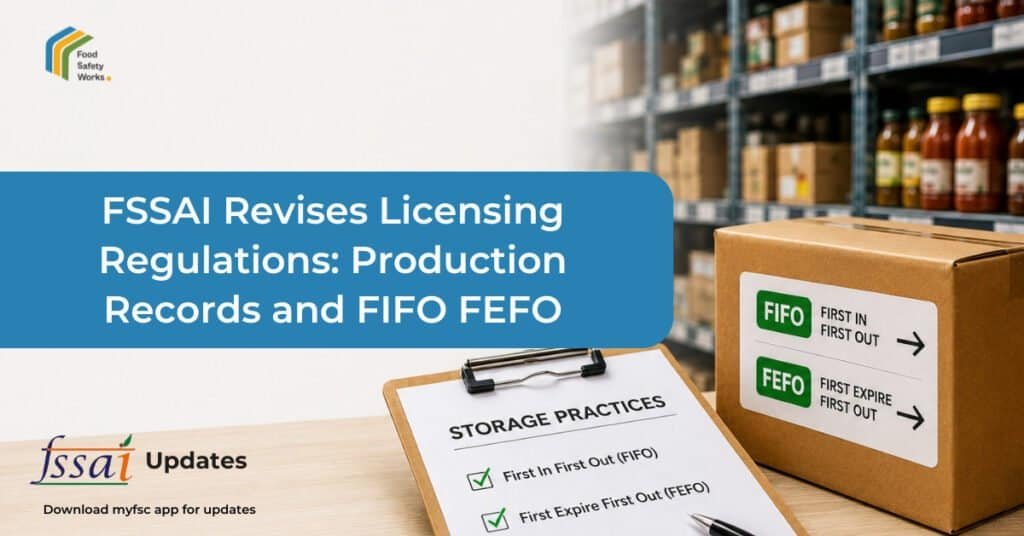
The Food Safety and Standards Authority of India (FSSAI) has notified important amendments to the Food Safety and Standards (Licensing and Registration of Food Businesses) Regulations, 2011. These changes simplify compliance requirements for different categories of Food Business Operators (FBOs). In particular, they provide clear exemptions for non manufacturing food businesses and retailers. As a result, businesses can focus on the compliance requirements that apply to their operations while manufacturers continue to maintain essential records and inventory controls.
The amendment revises two important provisions relating to production record maintenance and inventory management under the Licensing Regulations.
Daily Production and Raw Material Records Mandatory Only for Manufacturing Food Businesses
FSSAI has substituted Serial Number 8 under Annexure 3 of Schedule 2, which specifies the Conditions of Licence.
Revised Requirement
Manufacturing Food Business Operators must:
- Maintain daily production records.
- Maintain separate records of raw material utilization.
However, FSSAI has clarified that non manufacturing food businesses do not need to maintain these records.
What This Means
Earlier, the wording created uncertainty about whether every licensed food business had to maintain these records. Now, FSSAI has removed that confusion. Therefore, manufacturers must continue maintaining daily production records and raw material utilization records. Meanwhile, non manufacturing food businesses no longer have this obligation.
Examples of non manufacturing food businesses include:
- Retailers
- Distributors
- Wholesalers
- Storage facilities
- Transporters
- Food service establishments that do not manufacture food
Consequently, these businesses no longer need to maintain production related records that do not apply to their operations. This amendment reduces unnecessary documentation and improves regulatory clarity.
FIFO and FEFO Requirement Exempted for Retailers
FSSAI has also amended Paragraph 5.2.5 under Schedule 4, Part II, relating to Food Operations and Controls.
Revised Requirement
The storage of:
- Raw materials
- Ingredients
- Work in progress
- Processed food
- Cooked food
- Packaged food products
must continue to follow:
- First In First Out (FIFO)
- First Expire First Out (FEFO)
However, FSSAI has clarified that retailers do not have to follow this mandatory requirement.
Understanding FIFO and FEFO
FIFO and FEFO are standard inventory and storage practices used to manage stock efficiently and maintain food safety.
First In First Out (FIFO)
FIFO means businesses use or dispatch the oldest stock first. As a result, they rotate inventory properly and reduce the possibility of products remaining in storage for long periods.
First Expire First Out (FEFO)
FEFO means businesses use or sell products with the earliest expiry date before products with a later expiry date, regardless of when they arrived. Therefore, businesses can minimize product expiry and reduce food waste.
Impact of the Amendment
Overall, the amendment clearly defines which compliance requirements apply to each category of Food Business Operator. Consequently, manufacturers must continue following existing record keeping and storage practices, whereas non manufacturing businesses and retailers receive specific exemptions.
Manufacturing Businesses
Manufacturers must continue to:
- Maintain daily production records.
- Record raw material utilization separately.
- Follow FIFO and FEFO practices during storage.
Non Manufacturing Businesses
Non manufacturing food businesses no longer need to maintain daily production records or raw material utilization records because they do not manufacture food.
Retailers
FSSAI has exempted retailers from the mandatory FIFO and FEFO storage requirement under Schedule 4.
Nevertheless, retailers must continue following good food safety practices. They must also ensure that they do not sell or display expired food products, as required under the Food Safety and Standards Act and other applicable FSSAI regulations.
Why This Amendment Matters
These amendments align compliance requirements with the day to day operations of different categories of Food Business Operators. Therefore, businesses only need to comply with requirements that are relevant to their activities.
The amendment is expected to:
- Reduce unnecessary compliance burden on non manufacturing businesses.
- Clarify documentation requirements for manufacturers.
- Provide greater regulatory certainty for retailers.
- Improve compliance by clearly defining the responsibilities of different Food Business Operators.
- Enable more focused inspections based on the nature of the food business.
Summary of the Changes
| Provision | Earlier Requirement | Revised Requirement |
|---|---|---|
| Daily production records | Applicable to licensed food businesses | Applicable only to manufacturing food businesses |
| Raw material utilization records | Mandatory | Mandatory only for manufacturers |
| FIFO and FEFO storage | Applicable to all food businesses | Not applicable to retailers |
Conclusion
The latest amendment to the Food Safety and Standards (Licensing and Registration of Food Businesses) Regulations, 2011 brings greater clarity for Food Business Operators. Manufacturers must continue maintaining production records, raw material utilization records, and proper inventory management practices. In contrast, non manufacturing food businesses and retailers benefit from targeted exemptions that reduce unnecessary compliance requirements. Therefore, every Food Business Operator should review internal procedures and update compliance systems to align with the revised FSSAI requirements.
Want to stay ahead of FSSAI advisories and food safety regulations? Download the myFssai App for real-time alerts, enforcement updates, and expert compliance guidance all in one place by Food Safety Works.‘