To run a food business in India serving good food is as important as managing FSSAI compliance. The Food Safety and Standards Authority of India (FSSAI) monitors and enforces the Food Safety and Standards Act, 2006. Through which lays down rules for manufacturing, processing, storage, and sale of food.
Any deviation from these standards can lead to strict FSSAI penalties and punishments. Understanding these FSSAI penalties for non-compliance is essential for every food business operator (FBO). Whether you’re a manufacturer, distributor, or food retailer.
What Does FSSAI Non-Compliance Mean?
FSSAI non-compliance occurs when a food business fails to meet the requirements of the FSSAI Act 2006 or the associated regulations. This includes:
- Operating without a valid FSSAI license or registration
- Manufacturing substandard or unsafe food
- Selling misbranded or adulterated food
- Using false or misleading advertisements on food product labels
- Ignoring hygiene and sanitation standards in food processing facility
- Not following FSSAI compliance guidelines standards in the facility
Each violation attracts specific FSSAI fines or penalties, and in severe cases.
Key Offences and FSSAI Penalties under the Food Safety and Standards Act, 2006
Let’s look at some of the offences under the FSSAI Act and their corresponding penalties as per the official guidelines.
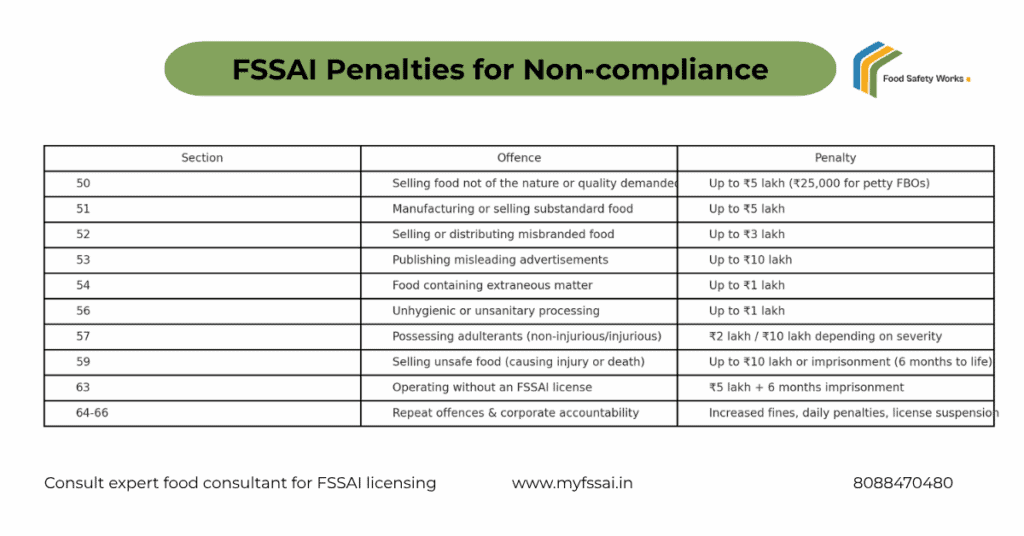
1. Selling Food Not of the Nature or Quality Demanded (Section 50)
If a food item doesn’t match what the buyer has demanded, the FSSAI penalty may go up to ₹5 lakh. For petty food businesses, the fine can go up to ₹25,000.
Example: Selling low-quality ghee or adulterated spices labeled as premium grade.
2. Manufacturing or Selling Substandard Food (Section 51)
Producing or distributing substandard food that doesn’t meet prescribed standards can lead to a fine of up to ₹5 lakh.
FSSAI penalty for non-compliance in this category is among the most common in small-scale food manufacturing units.
3. Misbranded Food and Misleading Advertisements (Sections 52 & 53)
Selling or marketing misbranded food for instance, products with false labels or deceptive packaging attracts a fine up to ₹3 lakh.
Running misleading advertisements about food quality or nutritional claims can result in a fine up to ₹10 lakh.
4. Food Containing Extraneous Matter (Section 54)
If your product contains foreign or unwanted substances not intended for consumption, the FSSAI fine amount can be as high as ₹1 lakh.
5. Unhygienic or Unsanitary Processing (Section 56)
Manufacturing food in unhygienic or unsafe conditions can lead to penalties up to ₹1 lakh. This provision reinforces the need for Good Manufacturing Practices (GMP) and Good Hygiene Practices (GHP).
6. Adulteration and Unsafe Food (Sections 57 & 59)
Adulterating food with harmful ingredients can lead to severe penalties.
- Non-injurious adulteration: Fine up to ₹2 lakh
- Injurious adulteration: Fine up to ₹10 lakh
- Unsafe food causing injury or death: Imprisonment from 6 months to life, plus fines up to ₹10 lakh
These are the most serious FSSAI punishments for non-compliance and can permanently damage your brand credibility.
7. Operating Without an FSSAI License (Section 63)
Every food business operator must have a valid FSSAI license or registration based on turnover and scale of operations. Running a food business without it can lead to:
- Imprisonment up to 6 months and
- Fine up to ₹5 lakh
This is one of the most frequent FSSAI penalties for non-compliance, especially for startups and small manufacturers.
8. Repeat Offences and Corporate Accountability (Sections 64–66)
For repeat violations, the Act allows for higher fines, daily penalties, and license suspension or cancellation. If the offence is committed by a company, both the organization and responsible managers or directors can be held liable.
FSSAI Penalty for Non-Compliance: Real-World Impact
FSSAI has increased its enforcement activities across India. Many FBOs have faced license suspensions and heavy fines for reasons like:
- Misleading food labels
- Poor storage hygiene
- Non-display of FSSAI license number in premises
- Sale of expired or adulterated products
How to Avoid FSSAI Penalties
Being proactive is the best defense against FSSAI penalties for non-compliance. Here’s how to stay safe:
- Obtain and renew your FSSAI license before expiry. Manage your FSSAI license renewal with myFssai with automatic tracking reminders.
- Maintain hygiene and sanitation standards across all food handling points.
- Label products accurately with ingredients, nutrition, FSSAI logo, and license number. Get your labels reviewed with expert Food Consultants like Food Safety Works.
- Avoid false or misleading claims in advertising and packaging.
- Train staff in FSSAI guidelines, GMP, and GHP and Hygiene training
- Keep documentation updated for audits and inspections. Manage all your documentation at one place in myFssai with updated audit score tracking dashboards.
- Monitor regulatory updates to stay compliant with new FSSAI rules and amendments.
Why Compliance Should Be a Priority
Food safety is not just a legal formality it’s a core business responsibility. Adhering to FSSAI norms helps you:
- Avoid costly FSSAI fines and penalties
- Build trust with customers and partners
- Access new markets with better credibility
- Ensure long-term business sustainability
Conclusion
The FSSAI penalties and punishments under the Food Safety and Standards Act, 2006 serve a clear purpose to ensure that every food business in India operates responsibly and transparently.
From small cafés to large-scale manufacturing facilities, FSSAI compliance is essential. Stay ahead of regulatory requirements by organizing all your facility’s compliance documents in myFssai keeping your business audit-ready at all times
FAQ
1. What are the FSSAI penalties under the Food Safety and Standards Act, 2006?
Under the FSSAI Act 2006, penalties range from ₹25,000 to ₹10 lakh, depending on the severity of the violation. Repeated offences or unsafe food production can also lead to imprisonment or license cancellation.
2. What is the FSSAI penalty for non-compliance?
The FSSAI penalty for non-compliance can include fines up to ₹5 lakh and imprisonment up to six months if a food business operates without a valid FSSAI license or registration.
3. What happens if a company sells substandard or unsafe food?
If a company manufactures or sells substandard food, it may face an FSSAI fine up to ₹5 lakh. Selling unsafe food that causes injury or death can attract imprisonment and higher fines under Section 59 of the Act.
4. Can a business lose its FSSAI license for repeated violations?
Yes. Under Sections 64 and 66 of the Act, repeated offences can lead to suspension or cancellation of the FSSAI license, and directors or managers may also be held personally liable.
5. How can food businesses avoid FSSAI penalties?
By maintaining hygiene, renewing their FSSAI license on time, following labelling standards, avoiding false claims, and keeping up with regulatory updates, food businesses can avoid FSSAI penalties for non-compliance.