Food catering is one of the fastest-growing segments in Bengaluru’s food industry. From corporate catering and wedding catering to cloud kitchens and event-based food services, catering businesses are serving thousands of consumers every day. However, operating a catering business without the required food safety approvals can lead to penalties, business disruptions, and reputational risks.
Obtaining an FSSAI License for Catering is not just a legal requirement it is an essential step toward building customer trust and ensuring compliance with food safety regulations.
Whether you operate a catering company, hotel kitchen, cafeteria, restaurant, sweet shop, or cloud kitchen in Bengaluru, understanding the licensing requirements can help you avoid compliance issues and run your business smoothly.
Is an FSSAI License Mandatory for Catering Businesses?
Yes. Under the Food Safety and Standards Act, 2006, every Food Business Operator (FBO) involved in preparing, handling, storing, transporting, distributing, or serving food must obtain FSSAI registration or licensing before commencing operations.
Catering businesses fall directly under the category of food service establishments because they prepare and supply food to consumers at various locations.
Operating without a valid FSSAI Catering License can result in:
- Monetary penalties
- Suspension of business activities
- Legal action by food authorities
- Loss of customer confidence
- Difficulty participating in corporate or government tenders
Displaying a valid FSSAI License also demonstrates that your catering operation follows prescribed food safety and hygiene standards.
Who Needs an FSSAI License in Bengaluru?
Any business involved in catering or food service activities in Bengaluru must obtain the appropriate FSSAI approval.
Examples include:
- Wedding caterers
- Event catering companies
- Corporate catering providers
- Hotel catering divisions
- Cafeteria operators
- Restaurant-based catering services
- Cloud kitchens offering catering
- Institutional food service providers
- Sweet and bakery catering businesses
- Food stalls catering at exhibitions and events
Even small-scale caterers serving local events must register under FSSAI if they are engaged in food preparation and supply.
Businesses operating from multiple locations may require additional licenses depending on their scale and operational structure.
Types of FSSAI Licenses for Catering Services
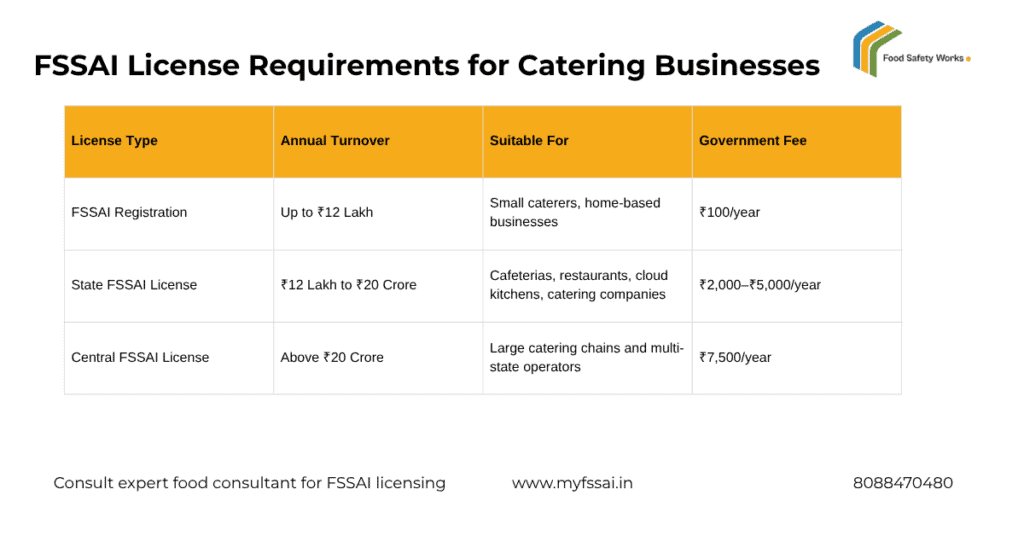
The type of FSSAI License for Catering depends primarily on annual turnover and business scale.
1. FSSAI Registration
This applies to small food businesses with an annual turnover of up to ₹12 lakh.
Suitable for:
- Small home-based caterers
- Local event caterers
- Small food service providers
Government Fee: ₹100 per year
2. State FSSAI License
Required for catering businesses with annual turnover between ₹12 lakh and ₹20 crore.
Suitable for:
- Medium-sized catering companies
- Restaurant catering units
- Cloud kitchens
- Cafeterias
- Institutional food service providers
Government Fee: ₹2,000 to ₹5,000 per year (depending on category and validity period)
Most catering businesses operating within Bengaluru fall under this category.
3. Central FSSAI License
Required when:
- Annual turnover exceeds ₹20 crore
- Operations are conducted across multiple states
- The business supplies food to airports, seaports, railways, or government establishments
Suitable for:
- Large catering chains
- National catering companies
- Multi-state food service operators
Government Fee: ₹7,500 per year
Selecting the correct license category is crucial because applying under the wrong category can delay approval or lead to compliance issues later.
Documents Required for FSSAI License for Catering in Bengaluru
The documentation requirement depends on the license category.
Commonly required documents include:
- PAN card of the business
- Aadhaar card of proprietor or partners
- Passport-size photographs
- Business address proof
- Rental agreement or ownership proof
- Partnership deed or incorporation certificate
- Food safety management plan
- Kitchen layout plan (where applicable)
- List of food products or services
- Contact details and email address
Additional documents may be requested depending on the nature and scale of operations.
Ensuring document accuracy significantly improves approval timelines.
How to Apply for a Bengaluru FSSAI License
The application process generally involves the following steps:
Step 1: Determine License Category
Identify whether your business requires Registration, State License, or Central License based on turnover and operations.
Step 2: Prepare Documentation
Collect all mandatory documents and verify that information is consistent across records.
Step 3: Submit Application
File the application through the FSSAI licensing portal with the relevant details and supporting documents.
Step 4: Department Review
The authority reviews the application and may request clarifications or additional information.
Step 5: Inspection (If Required)
Food safety officials may conduct an inspection of the premises before approval.
Step 6: License Issuance
Upon successful verification, the FSSAI License is issued with a validity ranging from 1 to 5 years.
Timely renewal is important to avoid penalties and business interruptions.
Benefits of Obtaining an FSSAI Catering License
Holding a valid FSSAI License for Catering in Bengaluru provides several business advantages.
Legal Compliance
Ensures your business operates according to food safety regulations.
Customer Trust
Consumers are more likely to trust caterers who display valid FSSAI credentials.
Better Business Opportunities
Many corporate clients, event organizers, and government departments require caterers to possess a valid FSSAI license before awarding contracts.
Brand Reputation
Compliance reflects professionalism and commitment to food safety.
Easier Expansion
Licensed businesses can scale operations more smoothly and obtain additional approvals when needed.
Conclusion
Obtaining an FSSAI License for Catering is a mandatory requirement for catering businesses operating in Bengaluru. Whether you manage a small catering service, restaurant kitchen, cafeteria, cloud kitchen, or large-scale catering company, having the right license protects your business and strengthens customer confidence.
Understanding the applicable license category, preparing accurate documentation, and ensuring timely compliance can help your catering business operate without regulatory hurdles. As food safety standards continue to become more important, maintaining FSSAI compliance is essential for sustainable business growth.
Frequently Asked Questions (FAQs)
1. Is an FSSAI License compulsory for catering businesses?
Yes. Every catering business involved in preparing or serving food must obtain FSSAI registration or licensing before commencing operations.
2. What is the government fee for a catering FSSAI license?
The fee ranges from ₹100 for Registration, ₹2,000–₹5,000 for State License, and ₹7,500 for Central License.
3. How long does it take to obtain an FSSAI License in Bengaluru?
Approval timelines vary based on documentation quality and inspection requirements. Most applications are processed within a few weeks.
4. Can a cloud kitchen providing catering services use the same FSSAI license?
Yes, provided the license category appropriately covers the business activities and operational scale.
5. What happens if a catering business operates without an FSSAI license?
The business may face penalties, regulatory action, suspension of operations, and reputational damage.