FSSAI license for warehouse operations is no longer a simple regulatory formality. With stricter food safety monitoring across India, warehouses, cold chains, and temperature-controlled storage facilities now sit at the heart of national compliance enforcement. Whether managing dry storage, chilled logistics, or controlled atmosphere facilities, every food storage operator must align with standards issued by Food Safety and Standards Authority of India.
For founders, supply chain heads, and quality managers, licensing is only the starting point. True compliance means documented processes, ongoing audits, trained staff, and real-time monitoring across every facility.
1. What Type of FSSAI License Is Required for Warehouse Owners?
The FSSAI license category depends on scale, turnover, and the geographical scope of storage operations.
Most warehouse and cold storage operators fall under:
- FSSAI State License for single-state operations
- FSSAI Central License for multi-state, import-export, or large-volume supply chains
Facilities storing high-risk products like dairy, meat, frozen foods, or ready-to-eat items are almost always directed toward Central licensing.
Typical FSSAI fees range from:
- Rs 2,000 to Rs 5,000 annually for State License
- Rs 7,500 annually for Central License
The license covers:
- Dry food warehouses
- Cold storage units
- Refrigerated distribution hubs
- Bulk commodity storage centers
Without proper licensing, shipments can be blocked, penalties imposed, and contracts suspended.
2. How to Maintain Process Compliance and Documentation in Storage Facilities
Facility compliance is the foundation of warehouse food safety. Inspectors review not just infrastructure but the discipline behind operations.
Key documentation includes:
- Temperature monitoring logs
- Cleaning and sanitation records
- Pest control reports
- Incoming and outgoing stock registers
- Product traceability records
FIFO reports play a critical role in preventing expired or compromised stock from entering distribution. These reports demonstrate that older inventory moves first, protecting shelf-life integrity.
In cold chains, inspectors pay close attention to:
- Equipment calibration
- Cold room mapping
- Emergency power backup logs
Manual systems often lead to missing entries and audit stress. Digital documentation ensures accuracy and faster inspection clearance.
3. Mandatory Compliance Requirements for Warehouses and Supply Chains
Food storage facilities carry legal obligations beyond daily hygiene.
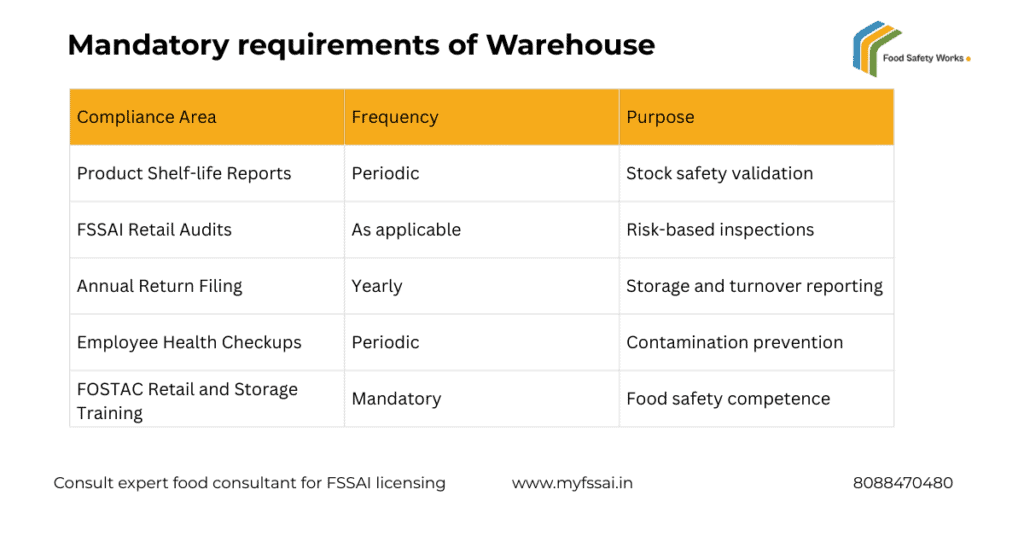
FSSAI Warehouse license renewal must be completed before expiry to avoid late penalties and business disruption.
These compliance elements protect food quality throughout the supply chain and ensure traceability during recalls or investigations.
4. How to Manage Multiple Facility Licenses Using myFssai
Large warehouse operators often manage:
- Multiple storage locations
- Different license categories
- Separate audit schedules
- Individual compliance timelines
Handling these manually creates serious risk.
With myFssai, operators can:
- Track every FSSAI license centrally
- Monitor renewal deadlines
- Upload compliance documents securely
- Schedule audits and training reminders
- Maintain facility-wise records
Instead of scattered spreadsheets, everything stays within one real-time compliance dashboard.
5. Track and Strengthen Compliance With Expert Consultant Support
Technology simplifies tracking. Expertise ensures correctness.
Food compliance consultants help warehouses:
- Interpret storage-specific regulations
- Prepare audit-ready documentation
- Address inspection gaps quickly
- Update processes with new FSSAI circulars
- Reduce penalty exposure
When digital compliance tools are paired with professional guidance, storage operators gain:
- Faster audit closures
- Lower operational risk
- Higher regulatory confidence
This becomes essential for cold chains handling sensitive food categories.
Storage Compliance is a business Priority
For warehouse owners and cold storage operators, food safety compliance directly impacts contracts, brand reputation, and business continuity.
From licensing to shelf-life management, FIFO tracking, audits, training, and renewals, every step shapes regulatory performance.
Digital compliance platforms like myFssai combined with expert food consultants transform complex obligations into a controlled, predictable process.
FAQs: Common Warehouse Compliance Questions
1. Is FSSAI license mandatory for cold storage units?
Yes. Any warehouse or retail facility handling the storage or processing of food products requires FSSAI licensing as per the Food Safety and Standards Regulation, 2011.
2. Which license is needed for multi-state warehouse operations?
The FSSAI Central License is required for the head office locations and the other multi-site locations can have FSSAI state or FSSAI central license depending upon their storage capacity
3. Are FIFO records checked during inspections?
Yes. FIFO compliance records and documentations needed to be maintained in the warehouse facility is closely reviewed to ensure product safety.
4. Is FOSTAC training compulsory for storage staff?
Yes. FoSTac Retail and Storage training is mandatory for your employees, At least one trained supervisor is mandatory per 25 peopole in an facility.