Every food business in India needs to understand FSSAI license fees before starting operations. The fee structure set by FSSAI applies to all types of food businesses manufacturing units, retail outlets, cloud kitchens, distribution centers, import businesses, transport operators, and large-scale processing facilities. Knowing these fees helps you plan your compliance budget.
In 2025, FSSAI continues to use a slab-based approach for calculating license fees. But, many food business operators find the structure difficult to navigate. The confusion stems from variations across business categories, license tenure options, production capacity limits, and state-specific requirements.
This guide provides a complete breakdown of the FSSAI license fees structure for 2025. It covers the costs associated with Basic Registration, State License, and Central License. You will also find details on FSSAI application fees, renewal charges, and pricing based on validity periods like FSSAI license fees for one year and FSSAI license fees for two year terms.
By reading this guide, food business operators will understand exactly how much they need to pay for their FSSAI license. It also explains how the myFSSAI portal makes the entire application and renewal process simpler and more transparent.
Why Understanding FSSAI License Fees Matters in 2025
Every food business is mandated to operate under the FSSAI framework. The cost of licensing becomes a recurring and operational expense, especially when a business expands production or adds new product categories. Many operators underestimate the fees because the structure depends on:
- Category of food activity (Kind of Business)
- Installed production capacity
- Annual turnover
- Type of premises (processing unit, warehouse, retail shop, e-commerce, etc.)
- Licensing authority (Central or State)
- Duration of the license (1–5 years)
Thus, a precise understanding of the FSSAI license fees structure is crucial before filing an application on FoSCoS.
Overview of FSSAI License Categories and Fees
Before diving into exact fee breakdowns, need to to understand how the FSSAI license categorization works. The three major categories are:
1. FSSAI Basic Registration (Turnover < ₹12 lakh/year)
This applies to small and micro food businesses. Fee range: ₹100 per year Valid for 1–5 years
2. FSSAI State License (Turnover ₹12 lakh to ₹20 crore/year)
Applicable for medium-scale manufacturers, processors, transporters, cold-chain units, retail chains, etc. Fee range: ₹2,000 to ₹5,000 per year Valid for 1–5 years
3. FSSAI Central License (Turnover > ₹20 crore/year or import)
Mandatory for large manufacturers, importers, multi-state operators, 100% EOUs, and airports/seaports. Fee: ₹7,500 per year Valid for 1–5 years
State authorities may modify fees slightly depending on food category structures, but the slabs remain fixed as per FSSAI guidelines.
Complete FSSAI License Fees Structure 2025
The updated fee structure for 2025 remains aligned with FoSCoS licensing rules. The following sections explain the fees in clear detail.
FSSAI Application Fees for Basic Registration
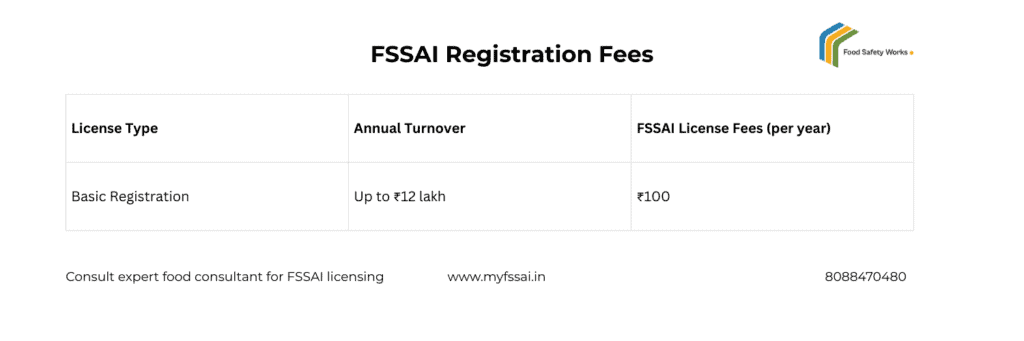
Businesses with minimal activities such as home-based food processors, small retailers, cottage industries, or petty food vendors fall under this category.
FSSAI Application Fees for State License
FSSAI State License fees vary based on the type of business activity:
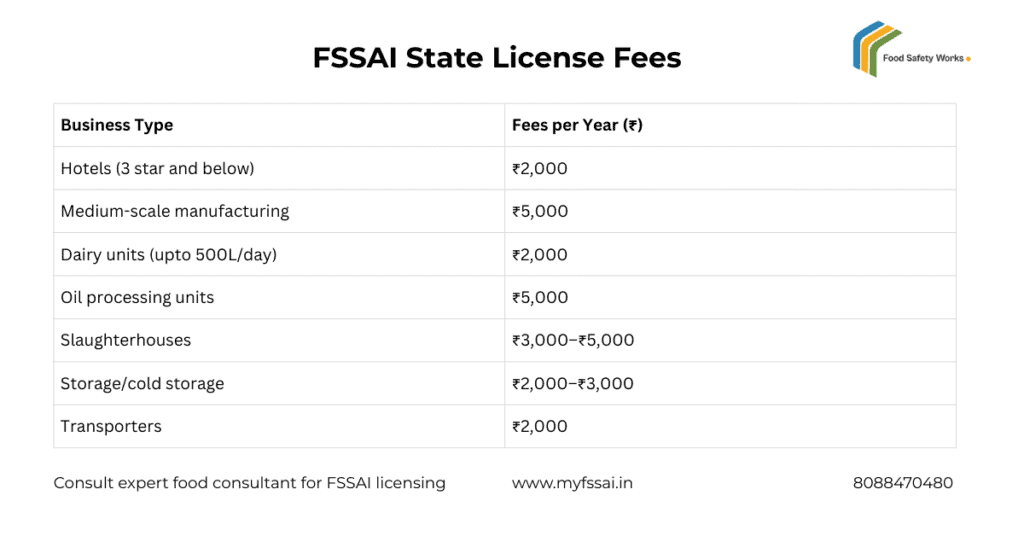
The fee increases with production capacity or number of vehicles.
FSSAI Application Fees for Central License
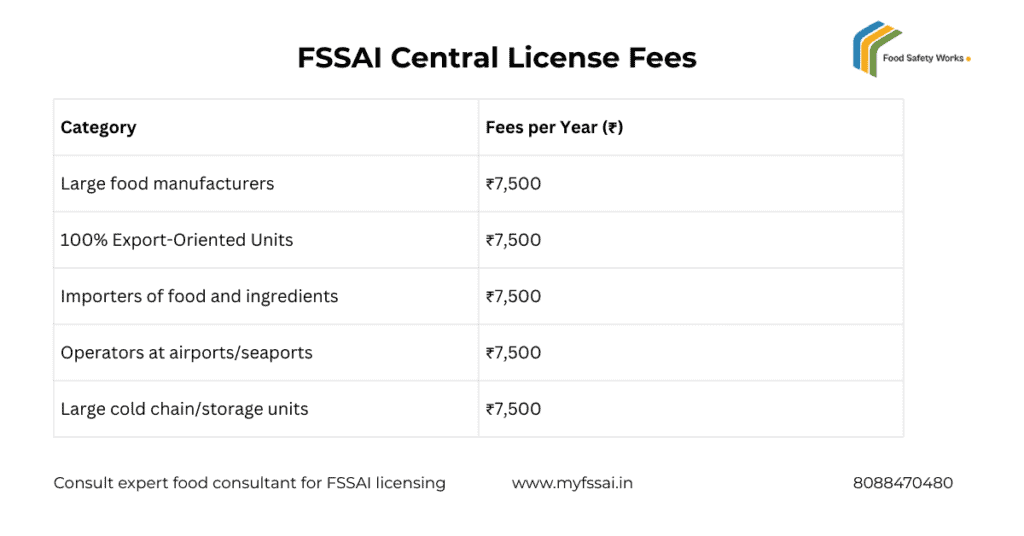
Central licensing applies wherever interstate operations are involved.
Hidden Costs Food Businesses Often Miss
Operators frequently overlook several indirect charges associated with licensing. These include:
1. Penalties for late renewal
If the license is not renewed on time, a penalty of ₹100/day is imposed until renewal is filed.
2. Re-inspection charges
Applicable when premises fail initial inspection.
3. Modification fees
Any major change (product category, layout, or business type) carries a Form-C modification cost of ₹1,000.
4. Document attestation fees
CA validation, plant layout certification, and other endorsements add to the cost.
5. Consultant or compliance support fees
Many food operators use compliance experts for documentation, which can vary in cost.
How myFssai Simplifies FSSAI License Fee Calculation
Many businesses struggle to identify the correct category, leading to wrong fee payments. myFssai solves this challenge by:
- Calculating the exact FSSAI license fees based on turnover, capacity, and activity by expert Food Consultants
- Predicting renewal costs
- Highlighting modification fees
- Avoiding double payments and rejections
This makes the licensing workflow predictable and completely transparent.
How to Raise a Service Request on myFssai (Step-by-Step)
Businesses can request support for license application or fee calculation using the following steps:
1. Visit the myFssai app
Login with your Phone and email ID.
2. Click “Raise Service Request”
Choose from available options including “Existing license” or “New license Application”. Then Click on the Service Request button and make a service request
- New FSSAI License
- License Renewal
- License Modification
- Fee Estimation Report
3. Enter basic business details
Such as:
- Turnover
- Food activity
- Business type
- Number of employees
- Production capacity
4. Upload supporting documents
PAN, Aadhaar, utility bills, layout plan, etc.
5. Submit the request
A compliance expert is assigned instantly.
6. Receive guidance
The expert will reach you back, helps determine the correct license category and fee
7. Application filing
The team prepares and files your FoSCoS application with accurate fee payment.
This eliminates all confusion around fees and documentation.
FSSAI license Renewal Fees Structure 2025
FSSAI License Renewal fees follow the same annual structure as FSSAI new applications. Renewal should be applied 90 days before expiry to avoid penalties.
Examples of FSSAI renewal fees:
- State License: ₹2,000–₹5,000 per year
- Central License: ₹7,500 per year
- Basic Registration: ₹100 per year
A delay beyond 30 days after expiry forces the operator to apply for a new license.
Additional Clarifications on FSSAI License Fees
1. Are FSSAI fees refundable?
No. Once paid, government license fees are non-refundable even if the application is rejected.
2. Are GST or service taxes applicable?
Yes, GST charges are there in FSSAI License fees payment
3. Can licensing fees vary across states?
FSSAI State License slabs are fixed, but certain states may apply minor variations depending on food activity.
Why myFssai Is the Preferred Platform for License Filing
myFssai’s compliance system removes the guesswork involved in licensing fees. It has been designed to support every food operator through:
- 100% assisted filing
- Renewal automation
- Document storage and management
- Expert support calls
This creates a seamless licensing experience for both new and established businesses.
Conclusion
The FSSAI license fees structure for 2025 remains one of the most important parts of compliance planning for food businesses. Whether a company is applying for a Basic Registration, State License, or Central License, accurate fee calculation ensures smooth and timely approval. Understanding the cost for various durations such as FSSAI license fees for one year or FSSAI license fees for two year helps in financial planning and regulatory preparedness.
With increasing regulations, digital compliance platforms like myFssai have become essential tools for food businesses. They not only simplify documentation and fee management but also reduce errors that lead to rejections or delays. By leveraging expert support, businesses can complete their licensing formalities confidently and efficiently.